Routes that shape the session
Outdoor formats ask for little equipment and almost no booking, yet they are anything but uniform. A grass loop in a city park, a gravel towpath, a forest with marked controls and a cold lake each produce a different kind of exercise. The newer outdoor trends mostly add a structure — a weekly time, a technique, a map — to activities people have always done.
parkrun: a weekly 5 km without ceremony
parkrun began in 2004 in Bushy Park, Teddington, when Paul Sinton-Hewitt organised a timed run for 13 people. The model has stayed simple: a free 5 km event every Saturday morning, run by volunteers, with each participant timed through a personal barcode printed or carried on a phone. It spread from south-west London to parks across the UK and many other countries.
What sets it apart is that it is not a race in the usual sense. People run, jog, walk, push buggies or bring dogs on a short lead where the course allows. A volunteer tail walker finishes at the back of every event, so nobody comes last alone. On Sunday mornings, junior parkrun offers a 2 km version for children aged 4 to 14.
Event locations, course descriptions and any temporary changes are published on parkrun's own website, which is the place to check before travelling to a course.
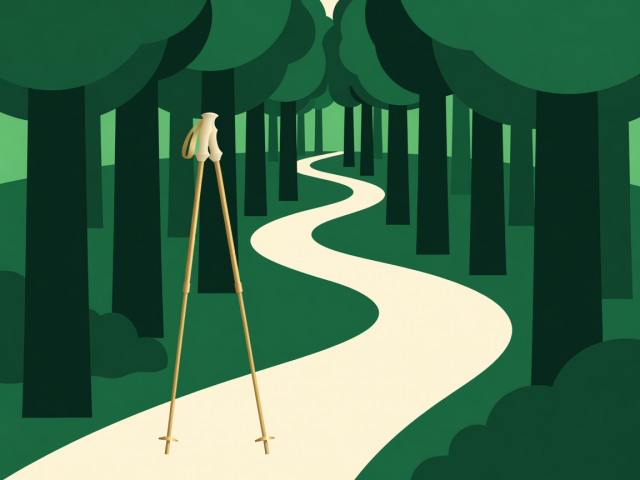
Nordic walking: poles that bring in the upper body
Nordic walking grew from the summer training of cross-country skiers in Finland and was popularised there as a fitness activity in the late 1990s. It uses purpose-made poles, shorter than ski poles, with a strap or glove that lets the hand open at the end of each push. The poles are planted at an angle behind the body rather than in front, so the arms and shoulders drive the walk forward.
The technique is what separates it from walking with trekking poles, which are mainly used for balance on rough ground. Many leisure centres, walking clubs and community health schemes run introductory sessions, because pole technique is far easier to learn with someone watching than from a description.
Loaded walking, maps and open water
Rucking, or walking with a weighted backpack, borrows from military marching. It turns an ordinary walk into strength-endurance work for the legs and trunk. The usual counsel is to begin light and increase load gradually, since the back and feet need time to adapt.
Orienteering adds navigation: participants find a series of marked control points using a detailed map. British Orienteering is the governing body in the UK, and many parks and forests host permanent courses that can be tried at any time with a downloadable map.
Outdoor swimming has a long history in Britain's lidos, rivers and lakes. The Outdoor Swimming Society, founded by Kate Rew in 2006, helped bring the activity back into wide view. Cold water carries real risks, covered on the recovery habits page.
For walkers seeking company and rights-of-way knowledge, the Ramblers, founded in 1935, remain Britain's best-known walking charity. Those who want a structured start to running can follow the NHS Couch to 5K plan, a nine-week programme that many people later take to a parkrun.
Terms you will hear on the route
- Tail walker
- The parkrun volunteer who walks at the very back of the field and finishes last.
- Pole plant
- The moment a Nordic walking pole touches the ground, ideally beside or slightly behind the opposite foot.
- Control
- An orienteering checkpoint, usually marked by an orange and white flag, recorded by punch or electronic chip.
- Loop and out-and-back
- A course that returns along a different path, versus one that turns at a midpoint and retraces itself.
- Acclimatisation
- The gradual adaptation outdoor swimmers allow before longer time in cold water.
Reading the setting before you go
- Check the surface: grass, gravel and mud change footwear needs and pace.
- Look at the weather and daylight, especially for early or late sessions.
- Know whether the route has toilets, shelter and a way to shorten it.
- Carry water and a phone, and tell someone your route if walking alone.
- For open water, use supervised venues and never swim alone.
General information only. People with balance, heart or breathing conditions should ask a GP or qualified professional which outdoor activities suit them.
Related paths
Recovery habits: saunas, cold water and the easier days between walks and runs.
Court formats: for when a booking and three partners sound appealing.