Smaller courts, different rhythms
Racquet and paddle games on reduced courts have spread from holiday resorts and community halls into converted warehouses and park corners. Their appeal is structural: shorter distances, compact strokes and doubles play that keeps four people within talking range. Each format still carries its own rules, walls and etiquette, and those details decide how a first hour on court feels.
Pickleball: a garden invention that kept growing
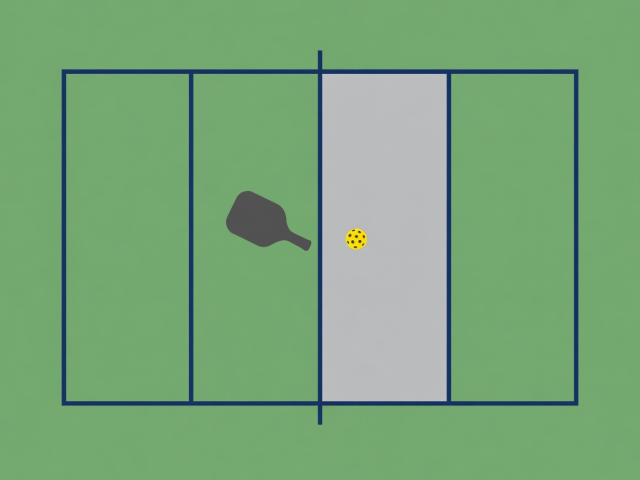
Pickleball began in 1965 on Bainbridge Island, near Seattle in Washington State, when Joel Pritchard, Bill Bell and Barney McCallum improvised a family game with table tennis bats, a perforated plastic ball and a lowered badminton net. The game kept the badminton-sized footprint: a court 20 by 44 feet, roughly 6.1 by 13.4 metres, which is why sports halls can often fit several pickleball courts where one tennis court would stand.
The defining feature is the non-volley zone, known to players as the kitchen: a strip extending seven feet from each side of the net in which you may not hit the ball out of the air. It slows the game down at the net and rewards soft, placed shots called dinks. Serves are underarm, and traditional scoring awards points only to the serving side, with games usually played to 11.
In the United States the sport is organised by USA Pickleball; in England, Pickleball England acts as the national governing body. Both publish rules and venue information that is kept current, which makes them the place to check before relying on any club listing.
Padel: walls become part of the point
Padel is usually traced to Acapulco in 1969, where Enrique Corcuera built an enclosed court at his home. Alfonso de Hohenlohe carried the idea to Marbella on Spain's Costa del Sol in the 1970s, and from there it took hold in Spain and Argentina long before reaching northern Europe. The International Padel Federation was founded in 1991, and in Britain the sport sits under the Lawn Tennis Association alongside tennis.
The court measures 20 by 10 metres and is surrounded by glass back walls and mesh sides. After the ball bounces on the floor it may be played off the walls, so rallies continue where a tennis point would have ended. Rackets are solid and perforated, without strings; the serve is underarm, struck at or below waist height. Scoring follows tennis, and the game is almost always played in doubles.
For newcomers, the walls are the main adjustment. Experienced players let the ball come off the back glass rather than chasing it, which makes padel less about sprinting and more about positioning and patience.
How the court formats line up
Tennis is included as a reference point, since most people know its court and scoring.
| Feature | Pickleball | Padel | Tennis (doubles) |
|---|---|---|---|
| Court size | About 6.1 × 13.4 m | 10 × 20 m | About 10.97 × 23.77 m |
| Enclosure | Open court | Glass and mesh walls in play | Open court |
| Implement | Solid paddle | Stringless perforated racket | Strung racket |
| Ball | Perforated plastic | Pressurised, similar to a tennis ball | Pressurised felt ball |
| Serve | Underarm | Underarm, after a bounce | Usually overarm |
| Scoring | Usually to 11, win by two | As in tennis | Points, games and sets |
Other small-court games worth recognising
Beach tennis grew up on the Adriatic beaches of Italy's Emilia-Romagna coast. It is played on sand with solid paddles over a high net, and the ball must not bounce, so points are short and played almost entirely at the volley. Soft sand makes footwork demanding even at a gentle pace.
Squash 57 is the game long known in England as racketball, renamed by England Squash after the 57 mm diameter of its ball. It uses a standard squash court but a larger, bouncier ball and a shorter racket, which gives beginners longer rallies than squash usually allows.
These games share the same principle as padel and pickleball: reduce the space or slow the ball, and new players reach a real rally sooner.
Before the first booking
- Check whether the venue lends paddles, rackets and balls, so the first session costs nothing in kit.
- Wear non-marking court shoes with lateral support; running shoes are built for forward motion, not sideways stops.
- Learn the serve rule for your format beforehand, since it is the most common source of early confusion.
- Look for social, open-play or beginner sessions, which solve the problem of finding three other players.
- Warm up the shoulders, wrists, calves and knees; short sprints and sudden stops are part of every game here.
- Agree with your partners who calls the score and which side serves first, and keep calls audible.
This is general information. People returning from injury, or with joint or heart conditions, should seek advice from a qualified professional before starting a fast-reaction sport.
Related paths
Outdoor movement: formats that need a route rather than a booking.
Strength formats: building the legs and shoulders that court games rely on.